AuthorJenn Frank

I started writing about videogames professionally in late 2005. I like vintage computer games and preservation, books, and horror games.

In a Field of ’90s Barbieland Wreckage, Chop Suey Got Gaming for Girls Totally Right

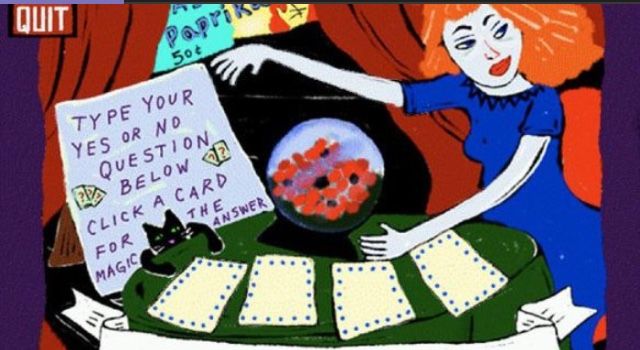
This piece inspired Rhizome to reissue Theresa Duncan’s three computer games. Thanks to Kickstarter support, the games were made available to play online. Developed in 1994 and published the following year, Chop Suey was a cunning piece of multimedia edutainment, suited just as well to grown-ups — smirking hipsters and punk rockers, probably — as it was to the prescribed “girls 7 to 12” crowd. But it wasn’t a computer game. It was something else: a loosely-strung system of vignettes; a psychedelic exercise in “let’s-pretend”; a daydream in which the mundanity of smalltown Ohio collides with the interior lives of its two young protagonists. As the game opens, the Bugg sisters are idling on a grassy knoll, counting clouds and recalling the day’s events. Lily and June Bugg, we are informed, have spent the afternoon with Aunt Vera. The narrator — a yet-unknown David Sedaris — sets the scene in nasally twee, occasionally...

Adventures in Shit Games: ‘Cho Aniki: Bakuretsu Rantou Hen’

some of the characters from Cho Aniki: Bakuretsu Rantou Hen

Earlier this month, New York University’s Game Center presented Bad is Beautiful, a playable exhibit of some of video games’ most brilliantly aberrant atrocities. At least one game was missing. “This is the crap avant-garde,” the exhibit’s website gushes. And the Game Center’s main mission — to champion garbage, to uncover the truth and beauty burning within even the most inane — sure is noble. The exhibit was poised, it seemed, to hone in on a type of videogame art brut. But the exhibit’s curator, Owen McLean, mmmmmight have courted controversy when he included GoldenEye 007 (N64, 1997) in the gallery lineup. The Internet became predictably indignant: Whaaaat? Who would do such a thing? And to be honest, I had to side with the Internet here. The GoldenEye games are classic! What was GoldenEye 007 doing in a “bad games” gallery exhibit? Maybe the exhibit had missed its mark. Where was the Typing of the Dead, the Takeshi’s Challenge...

A Conversation with Jake Elliott

Jenn Frank interviewed game developer Jake Elliott in time for last year’s Indie Games Festival, but once she had the entire interview in front of her, she hardly knew what to make of it. Elliott has remained busy, though: in the year since their interview, he has released Balloon Diaspora and Ruins. Elliott’s latest work, The Penguin’s Dilemma, is a reworking of an old NES puzzle game called Binary Land. Now it is a narrative about communication and love, requiring two players. The Penguin’s Dilemma will be a playable installation at Super Button Mashers, a gallery exhibit opening February 11 at Chicago’s OhNo!Doom. You can read the long version of the interview here. ——— Jenn: So you were actually nominated in [last] year’s IGF Nuovo category for A House in California. And this is an adventure game with really simple images, and simple, kind of graphical parser commands? Jake: Yeah. Jenn: I made my best childhood...

All the Spaces Between Us

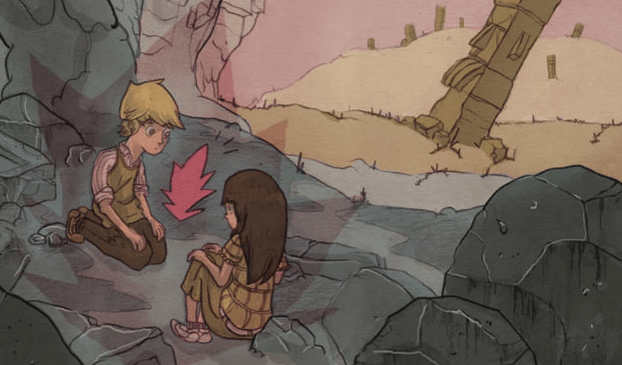
Cropped from the cover of Kill Screen issue 3: the Intimacy issue. An illustration of a boy and girl, sitting across from each other on the floor of a cave. Beyond the cave's mouth, what appear to be the ruins of an ancient civilization

Struggling to Connect in a Pixilated World The process of estrangement from self and others results from a declining sense of embodiment in social space and an associated diminishing of communication possibilities. …The dementing body is situated temporally and spatially in a known past as opposed to a confusing and incoherent present. From this basis, we can suggest that the not-uncommon ‘behavior’ of the sufferer who ‘wanders’ back to the house of his childhood is a motivated attempt to return to the security of a known ‘habitus.’ The logic of this argument is derived from the superficially self-evident notion that social and individual identities are tied to the body and its location in time and space.   —Christopher King “Cultural dimensions of dementia and care-giving.” Care-giving in dementia: research and applications, 1997. I. “Wow, you must really hate yourself.” That was Scott, typing at me from three city blocks away. “What,” I said aloud at my desk. “WHAT,” I...

Boogie (Wii)

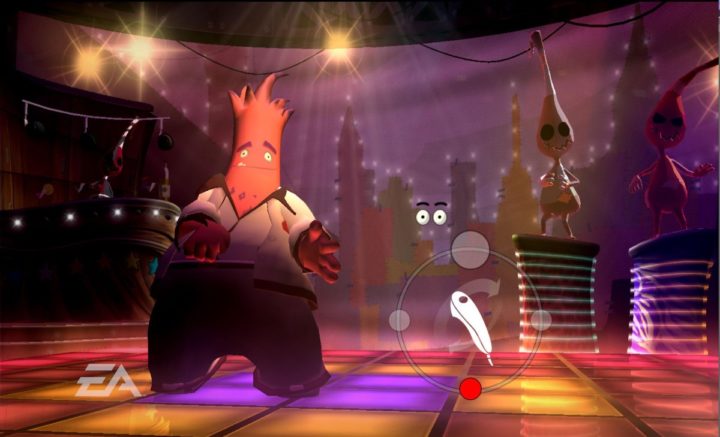
This review—slapped out in a fit of pique—is not particularly well written. But it’s notable for what happened next. For you see, my review of the early Wii title Boogie—which hit the Internet the moment the embargo lifted on August 7, 2007, two days before the game’s launch—was immediately denounced and ridiculed. People assumed that my low score, compared to the 4 out of 5 stars that GamePro had awarded the game, was the “wrong” score. I was delighted by this controversy, of course—and I would eventually be vindicated, in subsequent days and weeks, by Boogie’s rash of middling-to-poor reviews. Most exciting of all, MTV News actually interviewed the designer of Boogie to ask about my review; in it is the contention that the Wii is so new, reviewers still “don’t know how to review games for it.” I wrote a rebuttal, which was then also treated as news. So, chances are, you’ve heard of Boogie by now: It’s an ambitious mashup of...

Phoenix Wright: Ace Attorney—Justice for All (NDS)

Electronic Gaming Monthly, February 2007:

OK, guys. I’m split. I’m happy Capcom tried to make this sequel feel different with the Psyche-Locks (which make the exploration parts more difficult), but they don’t really improve gameplay. Instead, they simply serve to distract gamers from how much of a retread this truly is. Still, I loved the original, and I don’t feel the rehash rings hollow. The first Phoenix Wright game was a little bit better, a little more fulfilling, but DS owners looking to tackle another caseload will get a kick out of this.

LostMagic (NDS)

Electronic Gaming Monthly, June 2006:
What? I scroll away for one second to get a quick look-see at my minions, and I scroll back only to learn some monster has been punching my hero in the face repeatedly. Uncool. While its hybrid of game mechanics is truly nifty, Lost Magic quickly becomes a fast-paced terror of multitasking and micromanagement.
Granted, there’s an enemy-tracking GPS on the top screen that I ought to be watching, but it’s tough when the touch screen is flurried with tiny icons where I assumed actual graphics would be. Worse, characters can clump up during battle, which makes tapping the intended icon nigh impossible. If it weren’t for the killer music and Studio Ghibli stills, I would have immediately thrown my DS across the room.

Kingdom of Paradise (PSP)

Electronic Gaming Monthly, January 2006: In this hack-n-slash fest, you are Shinbu, one of the last members of an otherwise buried clan—and the hero of a really dry story. Despite your bizarre Larry Hagman eyebrows, Shinbu, your character model looks really good, even if your voice acting is stilted and scene-chewing. Nonetheless, you compensate for your shortcomings with fluid, responsive movements and nifty sword brandishing, making sweet combos with these Bugei scroll thingies you’ve collected. Unfortunately, Shinbu, you face infuriating opponents: Either they just stand there and take it like a sissy, or they whale on you relentlessly, which makes your quest a little bit no fun. Plus, weird glitches pop up once in a while, like that time you got a bomb stuck to your head and couldn’t shake it off. But we’ve got some terrific action going on here, Shinbu, and fast load times, to boot! So, Shinbu, if you can focus on your quest without getting frustrated or letting...

Jenn Frank

I started writing about videogames professionally in late 2005. I like vintage computer games and preservation, books, and horror games.